How AI Gateways Manage Multiple LLM Providers
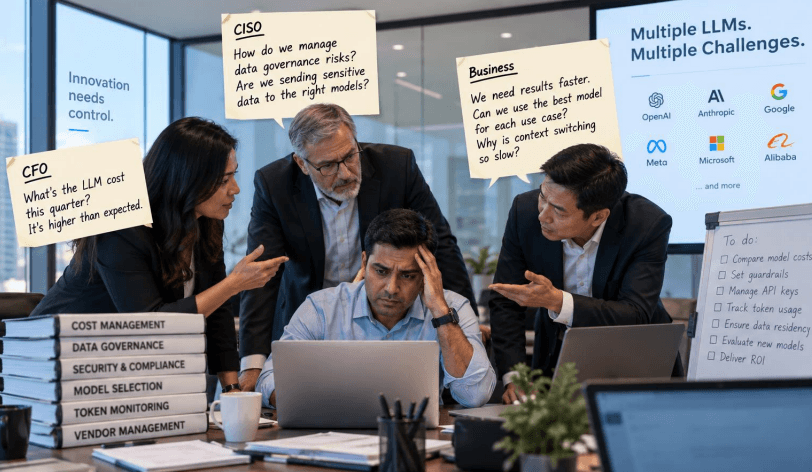
The CIO’s new problem is not choosing one AI model. It is managing many of them without losing control.
Generative AI has changed the enterprise technology equation. Business teams want the model that delivers the best result for each task; developers want to adopt new models quickly. Finance wants to know why token bills are rising. Security wants to know where sensitive data is going. Leadership wants measurable results now.
That is why the AI Gateway is becoming important to enterprise AI architecture. An AI gateway platform sits between applications, agents and model providers, creating a shared control layer for routing, context, guardrails, governance, observability and cost. Its role is to let teams move faster without forcing the CIO or Head of IT to choose between speed and control.
The multi-LLM reality: more choice, more operational burden
No single model is likely to serve every enterprise workload.
Customer service may prioritize speed and unit economics. Research assistants may need deeper reasoning and long context. Developer tools may depend on code generation. Regulated workloads may require a specific deployment geography or an approved model for sensitive data.
That flexibility is valuable, but each provider brings its own authentication, rate limits, pricing, context windows, failure modes and governance requirements. As teams integrate independently, API keys multiply, costs scatter across accounts, policies vary by application and provider outages become application outages.
The problem is no longer access to AI. It is governing access to AI at enterprise scale.
The CIO is caught between three demands
The CFO asks: “What are we spending on LLMs, and what value are we getting?”
The CISO wants to know which models are receiving enterprise data, what guardrails are in place, and whether compliance can be proven.
Business leaders ask: “Why can’t we use the best model immediately, get faster answers and scale token usage when demand rises?”
All three questions are legitimate, but answering them separately multiplies infrastructure and friction. An AI Gateway changes the operating model by centralizing controls that every AI application would otherwise build for itself.
One controlled entry point across multiple models
An AI Gateway provides one access layer between enterprise applications and approved models.
Applications connect once. The gateway handles model selection, credentials, routing, fallback, usage controls and policy enforcement. Teams can evaluate or change models without redesigning the full application.
It also reduces the hidden cost of context switching. Moving between models often means adapting prompts, context structures, tool definitions and output formats. Across dozens of applications and agents, that becomes operational debt.
A well-designed AI Gateway can preserve common context, normalize requests and responses, and manage provider-specific differences centrally.
Routing should become a business decision
The most capable model is not automatically the right model for every request.
A classification task may not need the same model used for contract analysis. High-volume summarization may prioritize latency and predictable cost. Sensitive workloads may be restricted to specific providers or locations.
An AI Gateway can turn these requirements into routing policy based on task type, cost ceiling, latency target, geography, context size, availability, security classification or required capability.
This changes the question from “Which model should we standardize on?” to “Which approved model is most appropriate for this request?”
Budget control is becoming as important as cloud cost control
Token consumption can grow quickly, especially with agents.
One user action may cause an agent to reason, retrieve data, call a model, use a tool, inspect the result and retry. The user interaction may be simple; the token chain behind it is not.
CFOs need to see which teams, applications and use cases consume tokens, what those tokens cost and whether the spend produces business value.
An AI Gateway creates a natural point for budget control. Organizations can set limits by team or application, monitor input and output tokens, detect abnormal spikes and enforce thresholds. Prompt caching, batching, routing and rate limiting can improve unit economics further.
The objective is not to minimize token usage. It is to make token consumption intentional and measurable.
Guardrails and governance cannot be an afterthought
The same control layer can become an enforcement point for security and governance.
Before a request reaches a model, policies can detect personally identifiable information, confidential content or other sensitive data. Guardrails decide which models are cleared for a given data class or use case, and a request that doesn’t meet policy can be blocked, masked, redirected or logged for review.
Outputs get checked on the way back too, for prohibited content, sensitive information or anything that violates policy.
For the CISO, this provides a technical point of enforcement and a consistent audit trail across multiple providers.
Resilience matters when AI becomes operational infrastructure
If an application is connected directly to one provider and that provider is unavailable, rate-limited or degraded, the business process may stop.
That is tolerable during experimentation. It is harder to accept when AI is embedded into support, fraud operations, software development or revenue workflows.
An AI Gateway can implement approved fallback paths. If the preferred model is unavailable or too slow, traffic can move to another model that satisfies defined quality, security and cost requirements.
Fallback should never mean sending sensitive data to whichever provider responds. It should mean moving between approved options under explicit rules.
Observability turns AI usage into operating intelligence
An AI Gateway can provide a common view of request volume, token consumption, latency, errors, routing decisions, fallback events, policy violations and cost.
The more valuable step is connecting those metrics to outcomes. What is the model cost per resolved support case? Which agent gives the best conversion rate? Which model delivers the best quality-to-cost ratio? Where does latency hurt adoption?
These are business questions, not merely engineering metrics.
The deeper opportunity: connect model economics with data economics
Models create value when they can use trusted data, semantic context, governed access and business logic. Enterprise AI is therefore constrained not only by the model, but also by the data architecture behind it.
This is why Cogrion positions the AI Gateway alongside the data platform rather than as an isolated connectivity layer.
When model consumption and enterprise data operations are managed together, governance can use data lineage and sensitivity, routing can reflect workload context, and token consumption can be connected to the business process that created it.
The future of enterprise AI will not be won simply by access to more models. Differentiation will come from how intelligently those models are orchestrated, governed and connected to trusted enterprise data.
From model choice to controlled AI execution
The enterprise AI stack is likely to remain multi-model. Providers will improve at different speeds, pricing will change, open models will become stronger and regulatory requirements will vary across markets.
Trying to solve that future by choosing one permanent provider is unlikely to work.
The better architecture is to separate applications from model dependency and put policy, economics, context and observability into a shared control layer.
That is the role of the AI Gateway.
For the CIO, it creates one architecture for answering the CFO, the CISO and the business: control the economics, enforce the guardrails, preserve choice and keep teams moving.
AI choice does not need to shrink. It needs to become manageable.
Frequently asked questions
Common questions about running multiple LLM providers behind one control layer.
An AI Gateway is a control layer between enterprise applications, agents and AI model providers. It centralizes model access, routing, authentication, guardrails, monitoring and cost controls, allowing organizations to use multiple models while maintaining consistent governance, security and operational visibility across teams and applications.
Multiple LLMs create different interfaces, pricing structures, context limits, security requirements and failure modes. An AI Gateway reduces this complexity by creating one governed access layer, so teams can switch or route between approved models without rebuilding controls or provider-specific integrations inside every application.
An AI Gateway can track token usage by model, team, application or project; enforce budgets and rate limits; and route simpler workloads to more economical models. It can also support prompt caching and batching, helping enterprises connect AI consumption with measurable business outcomes.
An AI Gateway can inspect prompts and outputs, detect sensitive information, enforce model access policies and maintain audit logs. This gives security teams a centralized enforcement point for guardrails, data handling and approved model usage instead of relying on controls implemented independently by every application team.
It should do the opposite. A well-designed AI Gateway separates applications from model-specific dependencies and makes it easier to evaluate, add or replace approved providers. Enterprises should still assess portability, routing policies, logs and integrations to ensure the gateway itself does not become a new source of lock-in.